Case study
Rifle Configurator Case Study: AI Images Behind a 1M-Visitor Site
Rifle Configurator case study: how coding agents generated the art for a 1.35M-visitor site over MCP, and the AI-illustrated guide that led $59,879 in sales.
Rifle Configurator went from a first commit to 1.35 million visitors in eleven months, and no human wrote its code. Coding agents built the pages, and the same agents generated the images for those pages by calling an image MCP tool in the middle of the work. That tooling grew into Dream Pixel Forge. This case study covers how the image side worked, which AI-illustrated guide led $59,879 in tracked retail sales for one product, and how to set up the same pipeline.
- visitors since launch
- 1.35M
- Vercel Web Analytics, first 11 months
- visitors a month
- 388K
- Vercel Web Analytics, trailing 30 days
- tracked retail sales in 30 days
- $326K
- Rifle Configurator media kit
- Disruptor sales from one FRT cluster
- $59,879
- 221 transactions, Apr 1 to Sep 11, 2026
What is Rifle Configurator?
Rifle Configurator is a firearms build and research site: an interactive AR-15 builder, hundreds of buying guides, and news articles about new guns and parts. The site has 473 guides, 372 news stories and reviews, and 45 interactive tools. Its owner, Aditya Bawankule, also builds Dream Pixel Forge, and wrote up the full story of the vibe-coded build: Codex writes the backend and the builder logic, Claude Code writes the content, and the owner has “not read a single line of its code.”
Most of the traffic is Google organic search. From June 17 to September 16, 2026, Search Console counted 522,000 clicks and 16.9 million impressions at an average position of 7.8. Monthly visitors grew 9x in six months, from 42,443 in March 2026 to 369,169 in August. The Rifle Configurator media kit now reports 388,493 visitors in the last 30 days and $326,026 in tracked retail sales over the same period.
Oct 2025
First commit. Codex writes the builder, Claude Code writes the guides.
Dec 2025
An image generation MCP server joins the agents' toolbox as supporting tooling.
Feb 2026
The FRT buyer's guide publishes with an agent-generated header.
Mar 2026
42,443 monthly visitors. Six months later the figure is 9x higher.
Jul 2026
The image tooling becomes Dream Pixel Forge, with an MCP endpoint any agent can call.
Aug 2026
369,169 monthly visitors.
Sep 2026
1.35 million visitors since launch, and 388,493 in the last 30 days.
Why a content site needs an image pipeline
Every guide needs a header. Every hub page needs a banner. Every tool needs a card, and every page needs Open Graph and square crops for social and search. The site repo holds more than 4,500 image files. No stock library covers niche firearm subjects at that volume, and a photographer cannot keep up with agents that publish more than two pages a day on average.
There is a second problem. In the build write-up, Aditya says the site “needs high-resolution product shots of things that are sometimes not in any image model's training data.” A new rifle, a specific trigger, or a particular optic on a particular upper: a plain text-to-image prompt gets these details wrong. That problem is why the tooling that became Dream Pixel Forge started as supporting tooling for Rifle Configurator.
How the coding agents generate images over MCP
The agents do not hand off to a design step. While Claude Code writes a guide, it calls the image tool over the Model Context Protocol, gets a file back, converts it to a 1920x1080 WebP, and wires it into the page in the same session. The site's skills make this the default: the guide research skill tells the agent that an AI-generated header is standard for guides, and names the tool to call.
Three things keep the output consistent over hundreds of pages:
- One style document. A single image style doc sets the look for every generation: cinematic, editorial, lit like war photography. The agent reads it before it writes a prompt, so a guide made in May matches a hub banner made in August.
- Separate styles for separate surfaces. The interactive tools use a second style: amber heads-up display art on black, at 3:2. A reader can tell a tool from a guide by the art alone.
- Reference images for real products. For a specific product, the agent passes a real photo as a reference and asks for a single change. One real edit prompt from the site: “Keep this exact photo of the AR-15 upper… Add ONE thing: mount a black EOTech EXPS3.” The product stays accurate, and only the requested change is new.

FRT hub banner

Ballistics calculator art
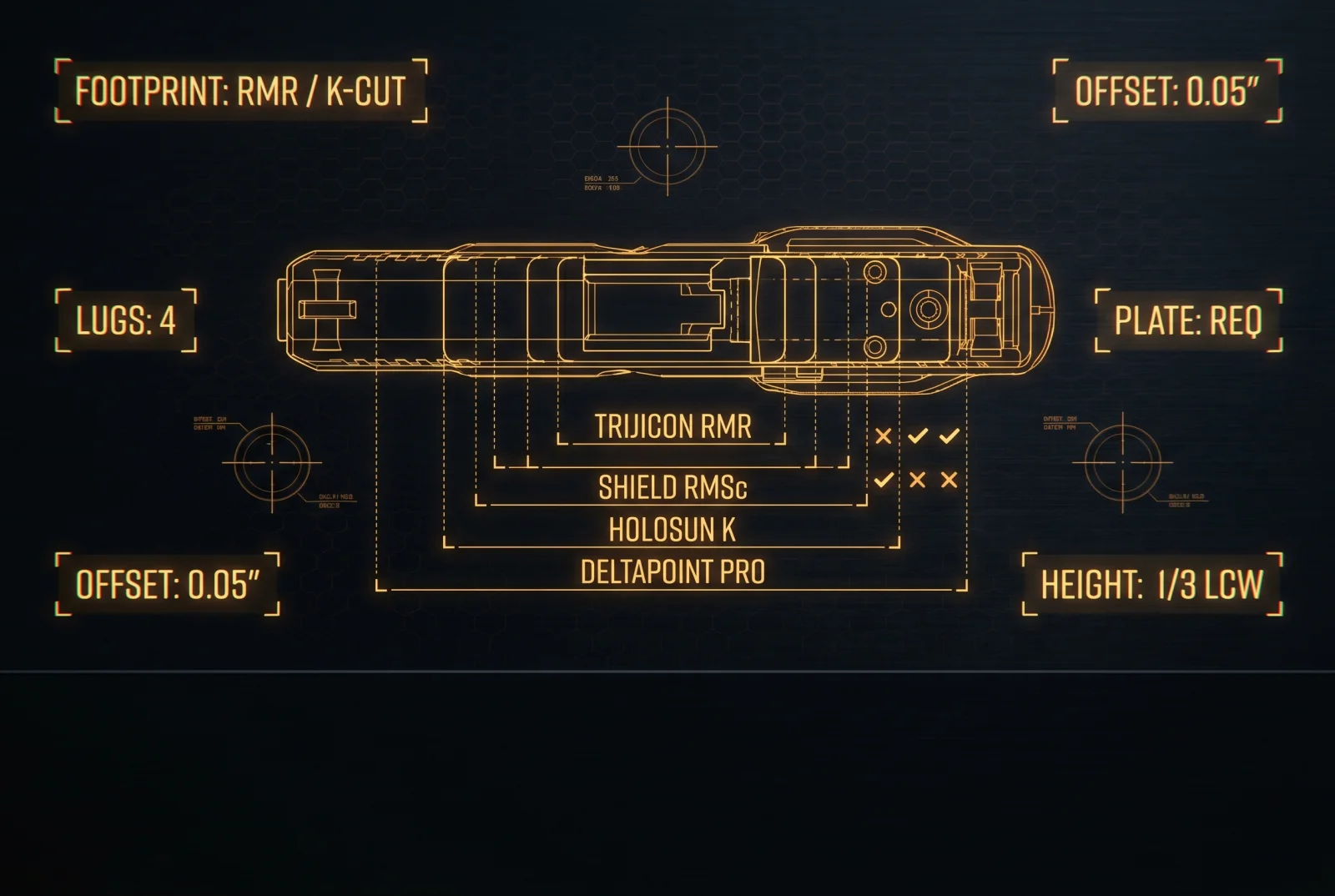
Optic compatibility art

Homepage hero, night variant
The FRT guide: $59,879 in tracked sales for one product
The best example is the Rifle Configurator FRT buyer's guide, a comparison of forced reset triggers such as the Rare Breed FRT-15L3, the Partisan Disruptor, and the AS Designs Arc Fire. It was published on February 9, 2026, with an agent-generated header. From April 1 to September 11, 2026, commerce reporting attributed 221 transactions and $59,879 in retail order value to clicks on the Partisan Disruptor alone. The buyer's guide led that total, and the Disruptor review and supporting pages kept the product in front of readers through the rest of their research.
The page also shows how the site splits the work between generated images and real photos. The header is atmosphere: a trigger group, a workbench, warm light. The product cards lower on the page use approved product images, because a buyer who compares two triggers needs the real part. Generated art gets the click and sets the mood. Accurate product imagery closes the sale.
The companion compatibility guide uses the same style, so the FRT cluster looks like one publication.
Where the human still matters
The agents write, generate, and publish, but one job stays with a person. In the owner's words, the job that is “still mine” is “catching the images that look slightly off.” A generated rifle with a wrong rail or an invented stock is a small error that an expert reader sees at once. On a buyer's guide, that small error costs trust, so the site keeps generated art on headers, hubs, and tools, and puts real or reference-locked images wherever a product detail matters.
Dream Pixel Forge builds that rule into the tools. The vision tool scores each image against the brief before the agent shows it to anyone, edit_image changes one detail and keeps the source image, and saved subjects keep a product the same across a full set of images. The site's agents now call Dream Pixel Forge over MCP for this work.
How to set up the same pipeline
The pipeline is one MCP connection and one style document. In Claude Code, add the server with a single command:
claude mcp add --transport http dream-pixel-forge \
  https://www.dreampixelforge.com/api/mcp \
  --header "Authorization: Bearer dpf_your_key_here"
Then do what Rifle Configurator did:
- Write a style doc for your site: the look, the light, the aspect ratios, and what the images must never show.
- Tell your agent, in its instructions or a skill, to read the style doc and generate a header for every new page.
- Give the agent real product photos as references for anything a buyer compares.
- Review the output for details that look slightly off before you publish.
The full setup for Claude Code, Cursor, and Codex is in our guide to the image generation MCP server. For a walkthrough inside the terminal, see how to generate images in Claude Code.
The bottom line
Rifle Configurator shows that a site built by agents can also get its art from agents, at the scale of more than 4,500 image files and 1.35 million visitors. The images did not rank the site. The content did that. But generated art let agents ship finished pages without a wait for design, and one of those pages led $59,879 in tracked sales for a single product. See the result at rifleconfigurator.com.