Guides
Tattoo Design Ideas for 2026: Find a Design You Won't Regret
A regret-proof process for tattoo design ideas: find meaning, learn the style vocabulary, check 2026 trends, and preview your own concept before booking an artist.
Most tattoo regret does not come from bad artists. It comes from walking into a consultation with a vague idea, picking something off the shop wall or a Pinterest board under time pressure, and discovering six months later that the design was never really yours. The fix is a process: start from meaning, learn the style vocabulary so you can describe what you want, check what is trending (and decide whether you care), and preview your actual concept in several styles before you book. This guide walks through that process end to end.
Start with meaning, not images
The strongest tattoo ideas start with something you want to carry, not something you saw. Before you open a single inspiration feed, answer three questions in plain words:
- What is this about? A person, a period of your life, a belief, an obsession, a joke you never want to stop telling. Tattoos anchored to meaning age better than tattoos anchored to trends, because the meaning does not go out of style.
- What is the subject? Meaning needs a vehicle. "My grandfather" is meaning; "his 1972 pocket watch, cracked at 4:15" is a subject an artist can draw. Concrete beats abstract at every stage of this process.
- Where does it live? Placement is a design decision, not an afterthought. A forearm wants a vertical, elongated composition. A shoulder wants something that wraps. A wrist or ankle can only hold a small, compact design before detail turns to mush.
Write the answers down. One sentence each is enough. That sentence is what you will iterate on, and it is what separates a design you commissioned from a design you copied.
How do I get a unique tattoo idea?
Combine a personal subject with a deliberate style choice, then iterate on variations until one version is unmistakably yours. Uniqueness rarely comes from inventing a subject nobody has tattooed before; almost every subject has been tattooed. It comes from the specific collision of your subject, your style, your composition, and your placement.
A practical method:
- List five candidate subjects from the meaning exercise above. Rank them by how you expect to feel about them in ten years, not by how they would look on social media this month.
- Add a specific detail to each. Not "a wolf" but "a wolf mid-shake, water flying off its coat." The detail is usually where uniqueness lives.
- Cross each subject with two or three styles. A raven in American traditional is a completely different tattoo than the same raven in fine line. Most people have never seen their idea in more than one style, which is why so many tattoos look interchangeable.
- Generate or sketch variations before you fall in love with any single version. The first rendering of an idea is almost never the best one, and iterating on paper or on a screen is free. Iterating on skin is not.
If you browse for inspiration, browse late in the process, after you know your subject and style. Used early, inspiration feeds converge everyone toward the same fifty images. Used late, they help you refine details on a concept you already own.
Learn the style vocabulary
Knowing the names of the major tattoo styles is the single highest-leverage thing you can do before a consultation, because it turns "something kind of thin and delicate?" into a sentence your artist immediately understands. The core vocabulary:
- American traditional. Bold black outlines, a limited palette of red, yellow, and green, classic flash motifs like roses, daggers, swallows, and anchors. Built to stay readable for decades.
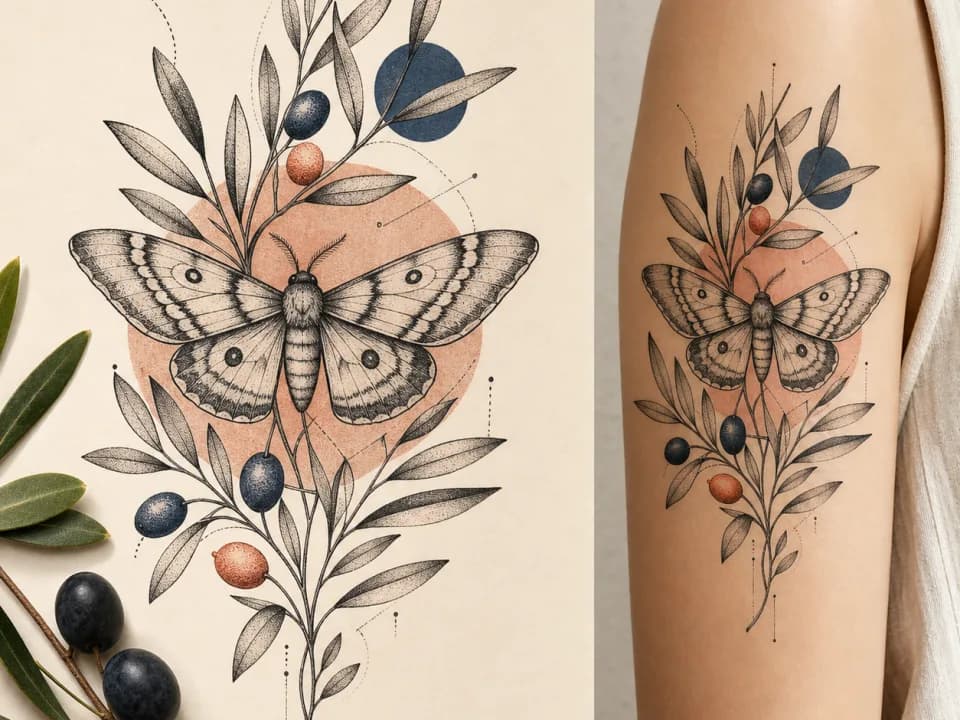
- Fine line. Delicate single-needle linework, minimal shading, elegant and subtle. Popular for script, botanicals, and small symbolic pieces. Ask your artist about long-term aging; very thin lines demand skilled execution to stay crisp.
- Blackwork. Dense solid black ink, high contrast, often bold geometric patterning. Graphic, striking, and among the best-aging styles because there are no subtle gradients to blur.
- Black and grey realism. Photorealistic detail rendered in smooth graded shading and soft grey wash. The go-to for portraits and lifelike animal or object pieces. Heavily dependent on the individual artist's skill.
- Geometric. Precise shapes, mandalas, dotwork, and symmetry, frequently blended with blackwork. Rewards careful placement because the geometry has to flow with the body.
- Japanese (irezumi). Flowing large-scale composition with waves, wind bars, koi, dragons, and other traditional motifs, usually in rich color. Designed for big canvases: backs, sleeves, thighs.
- Watercolor. Vivid paint splashes and soft color bleeds over sketched linework. Painterly and distinctive; discuss touch-up expectations, since soft color edges evolve more visibly over time than bold outlines.
You do not need to master all of these. You need to know which two or three could suit your subject, so you can compare them directly in the preview step below.
What tattoos are trending now?
As of 2026, the styles most consistently in demand are fine line and micro-realism pieces, bold blackwork and geometric designs, patchwork sleeves built from many small standalone tattoos, and a steady revival of American traditional flash. Script and single-word tattoos remain perennially popular, and large-scale Japanese-influenced work continues to hold its audience.
Two honest caveats before you chase any of these:
First, trends in tattooing move on a multi-year cycle, and your tattoo does not. A trend-driven choice is fine if the style also genuinely fits your subject; it is a poor reason on its own. American traditional is trending in part because people watched a decade of ultra-thin tattoos age and wanted something built to last, which tells you the cycle is real.
Second, "trending" partly reflects what photographs well, not what wears well. Fine line dominates social feeds because it looks stunning fresh and heals cleanly on camera. That is not an argument against it, but it is a reason to talk to your artist about line weight and long-term readability before committing to the thinnest possible version of your design.
Preview your idea before you commit skin and money
The most reliable way to avoid regret is to see your specific concept, in multiple styles and compositions, before you book anyone. A tattoo is one of the few purchases you cannot return, and "I will know it when I see it" is an expensive strategy at the consultation table.
This is where an AI tattoo generator earns its place in the process. Describe your subject in a sentence, pick a style like fine line, blackwork, or American traditional, and choose a placement. You get flash-style artwork of your idea in minutes, which lets you run the comparisons that actually matter:
- Style A versus style B, same subject. Seeing your raven in both blackwork and black and grey realism settles in thirty seconds what a mood board never resolves.
- Composition per placement. A design shaped for a back piece rendered at wrist scale immediately shows you what will and will not survive small. Placement-aware previews catch this before your deposit does.
- Detail stress-testing. If a background element muddies every variation, cut it now instead of debating it in the chair.
Generate eight or ten variations, sleep on them, and notice which one you keep returning to. Most people find their idea changes meaningfully once they can actually see it, and that change is the entire point: better to discover it on screen than in a cover-up consultation. You can try this with free trial credits and no account, so the cost of testing your concept is a few minutes.
One important framing: the preview is a reference for your artist, not a stencil to trace. More on that below.
How big is a $2000 tattoo?
In most US cities, $2,000 typically buys a large single-session piece or a multi-session piece in the range of a half sleeve, a substantial thigh piece, or the start of a back piece. The honest answer depends almost entirely on the artist's rate and the design's complexity, so treat everything here as commonly reported ranges rather than a quote.
The math most shops work from: established artists commonly charge somewhere between $100 and $300 per hour, with in-demand specialists above that and many shops enforcing a minimum charge of roughly $80 to $150 for even the smallest piece. At $150 to $200 per hour, $2,000 buys roughly 10 to 13 hours of work. What those hours produce varies by style: detailed black and grey realism is slow, bold traditional work covers area faster, and color generally takes longer than blackwork of the same size.
Rules of thumb, as commonly reported:
- Under $300: small, simple pieces at or near shop minimum. Script, small symbols, a single small fine line motif.
- $300 to $800: palm-sized to hand-sized designs with moderate detail. A detailed forearm piece often lands here.
- $800 to $2,000: large single pieces. Half sleeves frequently fall in this band, with detailed or color-heavy work pushing to the top of it or beyond.
- $2,000 and up: full sleeves, back pieces, and large Japanese-style work, usually across multiple sessions and often well past $4,000 for a full sleeve by an experienced artist.
Two spending principles that outrank all of the above. Never price-shop a permanent purchase down to the cheapest option; a mediocre tattoo plus the eventual cover-up costs more than doing it right once. And do your cheap iteration before the expensive hours start: every revision you settle on screen is a revision you are not paying an artist's hourly rate to discover.
From preview to appointment
Bring your favorite two or three previews to a consultation as references, and expect a good artist to change them. That expectation is the sign of a healthy process, not a failure of it. Artists work from reference art constantly; they will tighten line weights that would blur as the tattoo ages, adapt the composition to your actual anatomy, redraw the stencil themselves, and tell you honestly which elements will not survive at the size you want.
Choose the artist by portfolio fit with your chosen style. A brilliant realism artist is the wrong hire for American traditional, and vice versa. When you find the right one, listen to their input; they have watched hundreds of designs heal and age, and you have not.
The full process, condensed: meaning first, then a concrete subject, then style vocabulary, then previews of your own concept in competing styles and placements, then an artist whose portfolio matches the winning style. Follow it and the tattoo you get is the tattoo you actually wanted, which is the only regret-proofing that exists.