Guides
AI Generated Ads: Real Examples and How to Make Them
AI generated ads in 2026: real campaign examples, what AI ad creative is good at, the new disclosure rules, and how to make a campaign set from one brief.
AI generated ads are now ordinary. In 2026 they run on national television, in Super Bowl breaks, and in the endless churn of paid social, and most of the time the audience does not stop to ask how the image was made. The interesting question is no longer whether AI can produce an ad. It is which parts of an ad it produces well, what a campaign built this way actually costs, and what you are now legally required to tell people about it.
Short version: AI is very good at the volume work, which is scenes, variations, sizes, and cutdowns from a brief you already have. It is weaker at the thing that makes an ad work, which is a specific idea about a specific product for a specific buyer. The campaigns that landed in the last year all pair a human concept with machine production.
AI generated ads examples from real campaigns
Three campaigns are worth studying because they show three different economics. All three are below; watch them before reading the rest, because the gap between them is the whole argument.
Kalshi, NBA Finals, June 2025. The prediction-market platform aired a 30-second national spot built almost entirely in Google's Veo 3. Filmmaker PJ Accetturo assembled it in about three days from 15 usable clips out of roughly 300 to 400 generations, at a reported production cost of $2,000 (MarkTechPost). The spot is deliberately absurd, which matters: surreal comedy hides the artifacts that a straight dramatic scene would expose. Watch what it never asks the model to do, which is hold one face across two shots.
Coca-Cola, holiday 2025. After what the company called the first entirely generative-AI film on broadcast media in 2024, Coca-Cola's 2025 holiday campaign paired one traditionally produced film with two AI-made reimaginings of the 1995 "Holidays Are Coming" spot, built with the San Francisco studios Secret Level and Silverside AI (Coca-Cola). Both years drew public criticism. The lesson is not that AI failed technically; it is that a brand with decades of nostalgic equity spent some of it to save on production.
Svedka, Super Bowl LX, February 2026. The vodka brand's "Shake Your Bots Off" spot was the game's one explicitly AI-made commercial, produced with Silverside AI. It took roughly four months, including time spent reconstructing the brand's Fembot character and training the models to hold her expressions and movement, with humans developing the storyline (TechCrunch). This is the opposite requirement from Kalshi's: one specific character who has to look like herself in every shot, which is where the four months went.
Put Kalshi and Svedka side by side and you get the honest range. A throwaway concept with no continuity requirements costs a weekend and a couple of thousand dollars. A national brand spot with a recurring character and a brand-safe look costs months. AI moved the floor, not the ceiling.
The four kinds of AI ad creative
Most of what people mean by AI ad creative falls into four buckets, and they have very different success rates.
- Product and lifestyle scenes. Your real product photo placed into a generated environment: a kitchen counter, a gym bag, a summer picnic. This is the highest-yield category because the product pixels stay real and only the world around them is synthetic. See AI product photography for where it holds up and where it breaks.
- UGC-style creative. Handheld, imperfectly lit, talking-head or in-hand footage that looks like a customer shot it. Common on TikTok and Reels, and the category with the most legal exposure, because the whole point is a person who does not exist. Covered in UGC ads and AI UGC video.
- Static social and display banners. One concept resized into every placement a campaign needs. Nobody enjoys making the 12th banner size by hand, and this is where AI saves the most hours per dollar. See static ads, banner ad sizes, and Facebook ad sizes.
- Video. Short generated clips, animated stills, and cutdowns of longer spots. Quality has improved fast, and it is still the category where one bad frame kills the whole ad.

Product and lifestyle scene
Real product, generated world. The headline sits in reserved negative space rather than in the pixels.
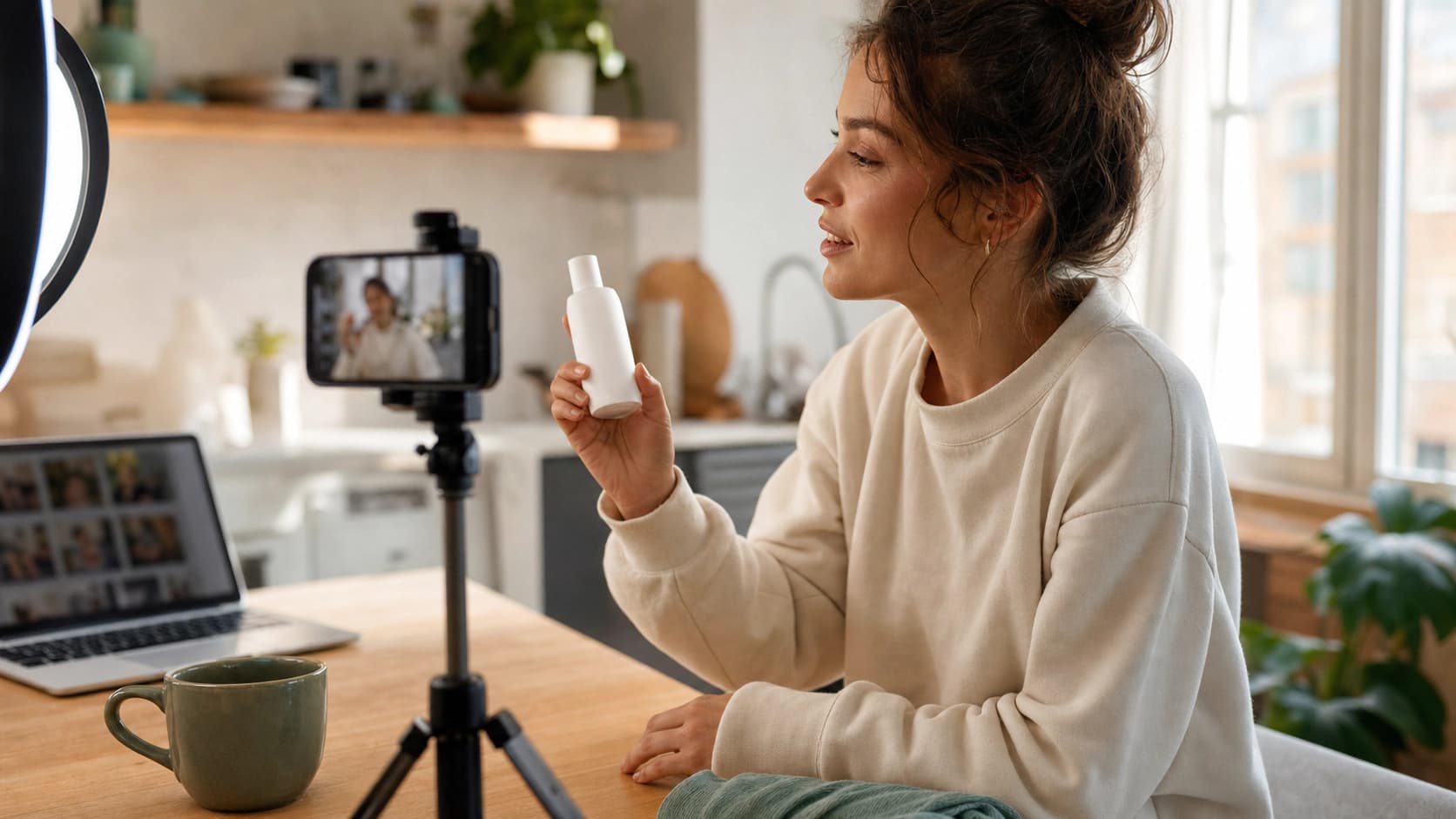
UGC-style creative
Reads as a customer filming a review. Also the category where the disclosure rules below actually bite.
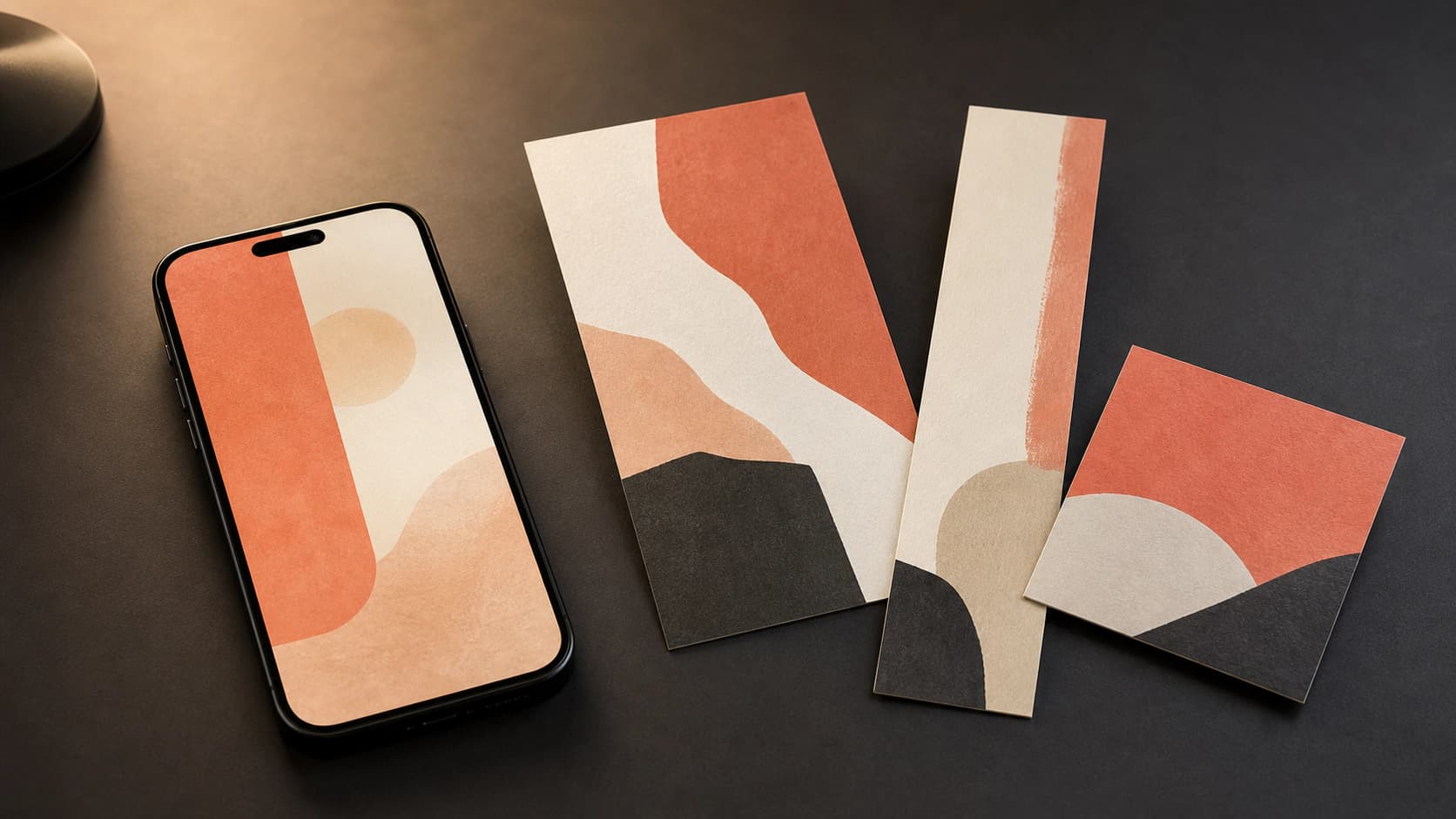
Static social and display
One concept, every placement. The dullest work in a campaign and the biggest hourly saving.
Video
Short clips, animated stills, and cutdowns. One bad frame still kills the whole ad.
If you are choosing where to start, start with statics. They are cheaper to generate, faster to judge, and a bad one costs you nothing but a scroll.
How to make ads with AI from one campaign brief
The workflow that works is not "write a prompt." It is to fix the campaign decisions once, then let the machine produce every asset that follows from them.
- Write the brief in one paragraph. Product, buyer, single claim, offer, and the feeling you want. If the claim is fuzzy, every generated variant will be fuzzy in the same way.
- Lock the brand facts. Palette, logo usage, tone, and the real product photography you have. These are inputs, not things to generate.
- Pick three angles, not thirty. One benefit angle, one objection-handling angle, one social-proof angle is a complete starting set. Volume comes from executions, not from strategies.
- Generate executions per angle. Product hero, lifestyle scene, bold graphic, UGC-style. Same claim, different visual language, so that the test tells you something about creative rather than about messaging.
- Reserve space for the copy. Generate the image with deliberate negative space where the headline and CTA will sit. Let the ad platform or your design tool set the type. Image models still garble small text, and a headline baked into pixels cannot be swapped per placement.
- Export every placement from the winner. Square and 4:5 for feed, 9:16 for stories and Reels, 16:9 for YouTube, plus the display banner set.
The ad creative variations tool is built for step 4: one subject, one set of brand colors, and a style and tone selection, producing a batch you can put in front of a media buyer the same afternoon. For display and retail placements, the ad banner generator handles step 6. The full workflow, brief in and campaign set out, lives on the AI ad generator page.
Try it now
Free to try, no account needed Example output
Your generated image will replace this example.
How to create ads with AI when you already have product photos
If you sell a physical product, do not ask a model to invent it. Upload the photo you already have and let the tool build the scene around it. Reference-image generation keeps the shape, color, and label roughly intact while replacing the environment, and a straight cutout and composite keeps your product's real pixels exactly. Either way, zoom to 100 percent and check the label text and any fine print before the ad ships, because that is where synthetic drift shows up first.
What the ad platforms now generate for you
Before you buy anything, check what your ad account already includes.
Meta. Advantage+ creative includes image generation, image expansion, text generation, video expansion, background generation for catalog ads, and image touch-up (Meta for Business). Meta has also told the Wall Street Journal it intends to let brands fully automate ad creation and targeting by the end of 2026, with a product image and a budget as the only inputs (Marketing Dive).
Google. Veo now sits inside Google Ads Asset Studio: upload up to three static images and each one produces a video up to 10 seconds long, packaged into ready-to-serve ads, available for all campaigns and for auto-generated Demand Gen (Google).
TikTok. Symphony Creative Studio generates TikTok-native video from minimal input, and everything it produces is automatically labeled as AI-generated, with invisible watermarking and C2PA Content Credentials attached (TikTok for Business).
The tradeoff with in-platform tools is control. They carry no separate subscription and they are tuned for that platform's auction, but the output lives inside the ad account, follows that platform's house style, and does not give you a reusable asset for your site, your email, or a different network. Generate outside the platform when the creative has to travel; use the built-ins when it does not.
Do AI-generated ads actually work?
They work in the same sense any ad works, and the honest evidence for a performance premium is thin. Meta's own marketing pages report modest, footnoted lifts for its generative features: roughly 2 to 3 percent conversion lift from background generation on Advantage+ catalog ads, about 2 percent on Facebook Reels from video expansion, and 13 percent more conversions when related media is used. Those are vendor figures for specific features, not proof that synthetic creative outperforms a good photograph.
The reliable gain is economic. When a variant costs cents instead of a shoot day, you can test ten concepts where you previously tested two, and the win comes from finding the outlier faster. That is a media-efficiency story, not a magic-creative story. It also has a floor: if all ten concepts say the same weak thing, generating them faster changes nothing.
The failure mode worth naming is sameness. Every advertiser prompting the same models with the same adjectives converges on the same glossy look, and audiences learn to skip it. The counterweight is specificity: your actual product, your actual customer's situation, a claim only you can make.
Is AI advertising illegal?
No. Using AI to make ads is legal in the United States and the EU. What is regulated is deception and disclosure, and the disclosure rules got real in 2026.
- New York. A first-in-the-nation synthetic performer law took effect June 9, 2026, requiring a conspicuous disclosure when an advertisement includes an AI-generated performer, meaning digitally created media that appears to be a real person (Office of the Governor). Law firm analyses of the statute put civil penalties at $1,000 for a first violation and $5,000 for each subsequent one, and note that it reaches any advertiser whose ads are seen in New York (Cooley).
- European Union. The AI Act's Article 50 transparency obligations apply from August 2, 2026, requiring that people be informed when content is AI-generated or manipulated (Article 50). Non-compliance is subject to fines of up to 15 million euros or 3 percent of total worldwide annual turnover, whichever is higher, with reduced caps for SMEs (Article 99).
- United States, fake testimonials. The FTC's Consumer Reviews and Testimonials Rule, effective October 21, 2024, bans fake and AI-generated consumer reviews and testimonials that misrepresent the reviewer's identity or experience (FTC). A synthetic person delivering a testimonial about a product they never used is the exact thing this rule exists to stop.
The platforms have built the plumbing for this. Google shipped an AI label setting in July 2026 across Google Ads, Display & Video 360, Campaign Manager 360, Merchant Center, and Ads Editor, citing the EU, India, and New York rules, and exempted those labels from its usual overlay and watermark restrictions (Google Ads policy). Meta applies an AI info label to ads created or significantly edited with its generative tools, shown behind the three-dot menu, or next to the Sponsored label when the ad contains photorealistic AI-generated people (Meta).
Practical reading: a generated background behind your real product is low risk and generally unlabeled. A synthetic human who appears to endorse your product is the high-risk case, and it is the one to run past counsel before it goes live. If you are building that kind of creative, the AI UGC generator makes it easy, which is exactly why the disclosure question belongs in your brief rather than in your legal review afterward.
How much do AI ads cost?
Three tiers, in practice.
- Inside the ad platform. Advantage+ creative, Asset Studio, and Symphony come with the ad account and carry no separate subscription. Best value per dollar, least portable output.
- Dedicated ad-video tools. Creatify lists a free tier at 10 credits a month, Starter at $39 a month for 100 credits, and Pro at $99 a month for 300 credits (Creatify pricing, checked July 2026). Priced for teams shipping video ads continuously.
- General image and video generation. Dream Pixel Forge starts free with 15 credits that refill while your balance is low, at 2 credits per image on the standard model, reference photo included, and up to 8 on premium models. Paid plans start at $12 a month for 300 credits; see pricing for the rest, including how video is metered.
For a full spot, the comparison point is Kalshi's roughly $2,000 and two to three days against a conventional broadcast production, and Svedka's four months against the same. The savings are real and they are not uniform.
The bottom line
Treat AI as the production department, not the creative department. Bring the idea, the claim, and your real product photography. Let the models handle scenes, variations, resizes, and cutdowns, which is where the hours actually go. Keep headlines out of generated pixels, check labels and fine print at full zoom, and decide up front whether your ad contains a synthetic person, because that single decision determines what you have to disclose. If you want the whole loop in one place, start with the AI ad generator and add video once a static concept has proven itself.