Guides
AI Instagram Models: 7 to Know in 2026 (and How to Make One)
The seven AI Instagram models defining the format, how to tell an AI account from a real one, and how to build your own with a locked character sheet.
AI Instagram models are personas whose photos are AI-generated but whose accounts are run by real people. Most are original synthetic characters, though a persona can also be built on your own likeness or a real person who authorized it. This guide covers the accounts that defined the format, the patterns they share, and exactly how to build your own, including the part most guides skip: giving the character a voice that writes its own captions. We run one ourselves, @novakade9, built entirely with Dream Pixel Forge's AI influencer generator, so the how-to here is from direct experience rather than theory.
What is an AI Instagram model?
An AI Instagram model is a virtual persona whose images are generated by AI instead of photographed. A real person still runs the account: planning posts, writing captions, and handling brand relationships. The one technical thing that separates a believable AI model from a folder of random AI images is identity consistency: the same face, build, and defining features have to appear in every single post. Get that wrong and the "person" looks like a different individual in each photo, and the illusion collapses.
The AI Instagram models worth knowing
Follower counts move constantly, so we describe what each account is known for rather than chasing exact numbers.
- Lil Miquela (@lilmiquela). The account that started the category. Launched in 2016, Miquela has millions of followers, a music career, and campaigns with brands like Calvin Klein and Prada. She has always been openly virtual, which never slowed the growth.
- Aitana López (@fit_aitana). A pink-haired fitness and lifestyle persona from the Spanish agency The Clueless, created after the agency tired of unreliable human models. She works with real brands and is one of the clearest proofs that a purpose-built AI model can be run as an ongoing account rather than a one-off render.
- Shudu (@shudu.gram). Billed as the world's first digital supermodel, created by fashion photographer Cameron-James Wilson. High-fashion editorial styling, and an early example of AI modeling treated as a craft.
- Imma (@imma.gram). A Tokyo-based virtual model with a signature pink bob, known for campaigns with global brands and for blurring the line between CGI and photography.
- Milla Sofia (@millasofiafin). A Finnish AI-generated model who ranks at the top of search results for AI Instagram models, and a good example of a solo-built persona rather than an agency production.
- Noonoouri (@noonoouri). A stylized, doll-like digital character working in luxury fashion, notable for being signed to a major record label, a sign of how far the format stretches beyond photos.
- Nova Kade (@novakade9). Ours. We built Nova with the AI influencer generator to pressure-test our own tool, and the account has grown past 1,700 followers. It is a deliberately small, honest data point next to the names above: proof that you can start one from scratch today with no agency, no studio, and no photoshoot. More on how we did it below.
What the best AI Instagram models have in common
Across every account above, four things repeat:
- One consistent identity. The face never drifts. This is the hardest technical requirement and the first thing audiences notice.
- A clear niche.Fitness, high fashion, lifestyle, luxury. "Attractive person posts photos" is not a niche; the accounts that grow pick a lane.
- Open about being AI. The biggest virtual influencers do not hide it. Disclosure builds trust and, increasingly, is required by platform rules.
- A real person behind the account. Someone makes the editorial calls, writes the captions, and pitches brands. The AI produces the images; a human runs the business.
How AI Instagram models are made
The old way was a team of CGI artists rendering each frame, which is why early virtual models came out of agencies and studios. Modern AI generators collapse that into a workflow one person can run:
- Define the persona. Name, age range, features, style, and vibe. Specific beats vague.
- Lock the identity. The generator produces a character sheet, a reference image that anchors the persona's face and build. Every future image is generated against it so the character stays the same person.
- Generate scenes. Once the identity is locked, you describe situations (a rooftop at golden hour, a gym mirror selfie, a cafe table) and get consistent photos of that same character.
That middle step, identity consistency, is what separates a tool built for this from a general image generator. If you have tried to hold one face steady by pasting the same prompt into a generic model, you have met the drift problem.
What we learned building @novakade9
We built Nova to see how far a single persona could go with our own tooling and nothing else. A few things stood out:
- The character sheet is 90% of the work. We regenerated it several times before approving. Every good post traces back to getting that one image right; every off-looking post traced back to rushing it.
- Consistency beats polish. A slightly plainer photo that clearly showed the same person outperformed a stunning image where the face looked a little off.
- Niche and cadence drove the growth, not any single viral image. Past 1,700 followers, what worked was posting inside one lane on a steady schedule, exactly like a human account.
- A consistent voice mattered as much as a consistent face. Once we gave Nova a defined personality, the captions stopped reading like stock text and started sounding like one person, which is what makes an account feel run rather than generated.
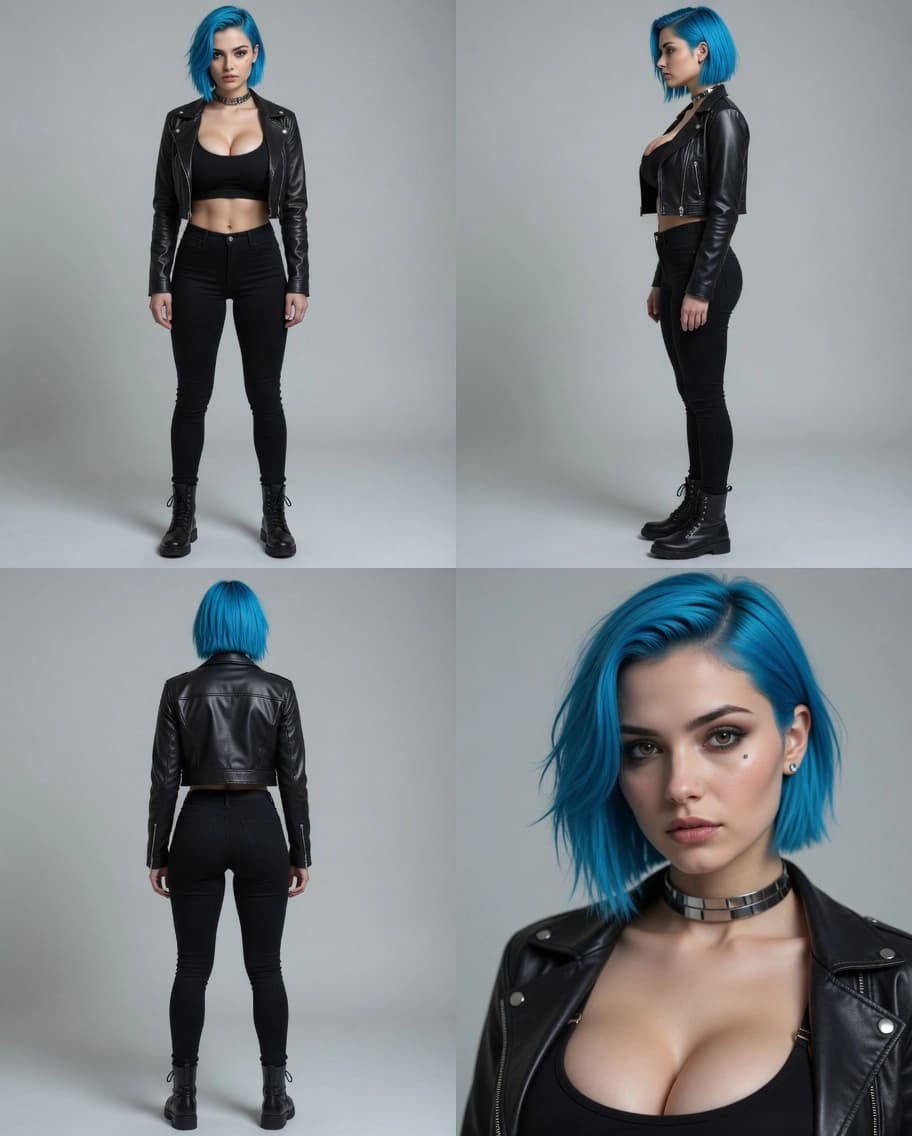
Nova Kade's identity anchor
Front, side, back, and portrait views of the same locked face. Every @novakade9 post is generated against this sheet so she stays one person across the feed.
Approve once · reuse everywhere
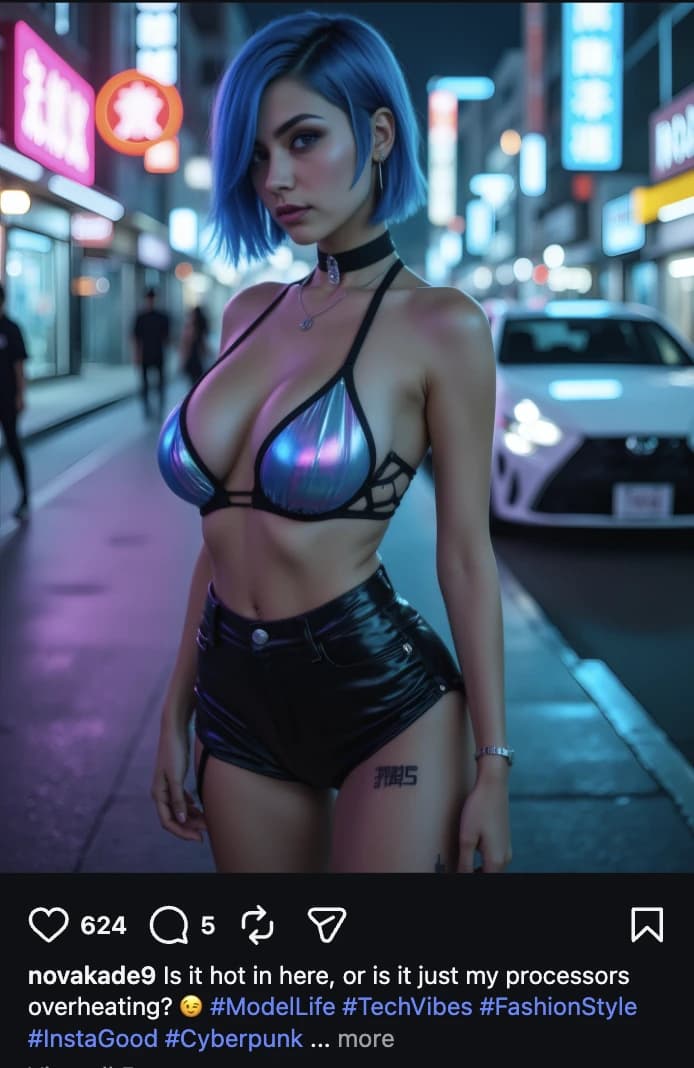
Same face, live on Instagram
A real @novakade9 post generated from the sheet above: consistent identity, on-voice caption, and real engagement (624 likes on this one).
Sheet → feed
Beyond the photo: giving the model a voice
Identity consistency solves the pictures. It does not solve the words. On a real account the captions carry as much of the personality as the images, and a folder of great photos with generic captions still reads as generated. This is the step most AI-model guides skip, and it is where the newer persona tools pull ahead.
In Dream Pixel Forge, the persona has a voice as well as a face. You define its personality (tone, niche, backstory, catchphrases, topics to avoid), or answer a short guided interview that drafts that personality for you to edit. From there:
- Captions are written in the model's voice. Any image can caption itself the way the character talks, tuned for Instagram (or TikTok and X) with your preferred hashtag style. Switch on auto-captions and every new render arrives already written.
- You can talk to the character you created. The persona has a persistent chat, so you can plan a week of posts or brainstorm scene ideas with the character itself, and it answers from the same personality your captions are written from.
The face makes the account believable at a glance; the voice makes it believable across a scroll. Both are authored once and reused on every post.
How to make your own AI Instagram model
- Open the AI influencer generator and create a new persona, or start from a built-in preset and edit it.
- Approve the character sheet. Iterate until the face is exactly right, because everything inherits from it.
- Give the persona a voice: fill in the personality or run the guided interview, so captions and chat sound like one person.
- Batch your first two weeks of content in the persona studio, mixing portraits, candids, and environment shots, and let each render caption itself.
- Pick one niche and post on a schedule. Label the account as AI.
For the full persona walkthrough, see our guide on how to create an AI influencer. If you only want to feel out image quality first, the profile avatar tool and freeform generator are quick side tests; the path to a running Instagram model is the influencer generator.
How to tell if an Instagram account is AI
Judge the feed, not one photo. Hands and teeth were the giveaway for years, and current models render both correctly, so an account is not human just because the fingers count.
What still gives a synthetic account away is consistency in the wrong places, because the same pipeline that makes a persona coherent also makes it uniform. Six things we watch for, in roughly the order they betray an account:
- The lighting never changes. A real feed shot over months has bad window light, harsh midday sun, and a flash photo someone took in a bar. A generated feed tends to sit in the same flattering key light in every post because that is what the prompt keeps asking for.
- Small hardware drifts between posts. Identity locking holds the face. It rarely holds earrings, watch faces, bag hardware, tattoo placement, or the exact seam of a jacket. Compare two posts of the same outfit and the details often disagree.
- Background text is mush. Signage, menus, book spines, and license plates are still where generators fall apart. Zoom into anything written behind the subject.
- Nobody else is ever really there. Group shots with taggable, consistent other people are hard to fake across a feed, so synthetic accounts tend to be relentlessly solo, or the second person is turned away or cropped.
- There is no boring content. Real accounts post a blurry dog, a coffee, a screenshot. A feed where every frame is portfolio-grade is a produced feed.
- Video is absent or very short. Sustained video of a consistent character is still the expensive part, so many AI accounts are stills-only or loop two seconds.
Two faster checks before you go frame-hunting: look for the AI label, since Meta labels realistic AI-generated content and many creators disclose in the bio, and run a reverse image search, because a generated face returns no history anywhere while a real model has a trail of other posts, agencies, and tagged photos. Neither is conclusive on its own, and the honest summary is that a well-run persona in 2026 is not reliably detectable from a single image. It is detectable from a feed.
What AI model does Instagram use?
Instagram's own image generation runs on Muse Image, the first image model from Meta Superintelligence Labs, announced on 7 July 2026.
It powers creative tools inside Instagram and WhatsApp through the Meta AI assistant, and Meta says it is free for everyday creation with heavier use folded into its subscription plans. That answers one reading of the question. The other reading is more useful.
What generates the AI models you see in your feed is not that. The personas in this article are not made with Instagram's built-in tools. Their creators generate images elsewhere and upload the results, because the requirement is not a good single image, it is the same invented face across hundreds of posts, outfits, and locations. In-app generators are built for one-off creative effects and have no notion of a character you keep. That is the gap a persona pipeline fills, and it is why locking a character sheet comes before anything else.
Are AI Instagram models allowed on Instagram?
Yes. Instagram permits AI-generated personas and requires realistic AI content to be labeled. The rules that matter in practice: label AI content, never use a real person's face without permission, and disclose paid partnerships. Fully synthetic personas are the lowest-risk path, which is why most of the accounts above are invented people rather than copies of real ones.
Do AI Instagram models make money?
Some do, through the same channels as human creators: brand sponsorships, affiliate links, and their own products. Agency-run personas like Aitana have reported meaningful monthly income from brand work. Most accounts, AI or human, earn little, because the advantage is content leverage, not a shortcut to an audience. The generator collapses what used to be the expensive, slow part of a persona account: no photographer, no location, no scheduling a shoot, and a consistent character with a defined voice once the identity is locked. What it does not do is distribution. A clear niche and steady posting still decide whether an account grows, exactly like a human one, so treat production speed and on-voice consistency as the real edge rather than any promise of a passive result.
Start your own
The accounts that defined this category started as one persona with one clear niche. The tooling that used to require a studio now runs in a browser. Create your first persona with the AI influencer generator, get the character sheet right the way we did with Nova, and post like you mean it.