Guides
Open Source AI Video Generators: What Runs in 2026
Every open source AI video generator worth downloading in 2026: LTX-2.5, MiniMax H3, Wan 2.2, HunyuanVideo 1.5. Licenses, VRAM floors, honest trade-offs.
The honest shortlist for an open source AI video generator in August 2026 is four names long: LTX-2.5, which Lightricks released today, MiniMax H3, Alibaba's Wan 2.2 family, and Tencent's HunyuanVideo 1.5. Everything else you will find in a roundup is either a 2024 research checkpoint that nobody has updated, or a version number that does not exist as downloadable weights. This guide covers what is actually on Hugging Face right now, what each license permits, what hardware each one demands, and where running your own weights stops making sense.
Every license term, VRAM figure, and release date below came from the model card or the maker's own announcement while writing. In this category that matters more than usual, because the gap between what a model page claims and what a third-party listicle repeats has gotten wide.
The open weights you can download today
Four things separate these models in practice: the license, the VRAM floor, whether audio comes out of the same pass, and whether the tooling ecosystem exists yet.
| Model | Maker | License | Hardware floor |
|---|---|---|---|
| LTX-2.5 | Lightricks | LTX-2 Community License, free under $10M ARR | Consumer RTX, DGX Spark, or Mac; fp8 and NVFP4 checkpoints |
| MiniMax H3 | MiniMax | MiniMax H3 Community License, attribution required | 4 GPUs in MiniMax's own deployment recipe |
| Wan 2.2 TI2V-5B | Alibaba | Apache 2.0 | 24GB, runs on a single RTX 4090 |
| Wan 2.2 T2V-A14B | Alibaba | Apache 2.0 | 80GB recommended for single-GPU inference |
| HunyuanVideo 1.5 | Tencent | tencent-hunyuan-community | 14GB with model offloading |
| Wan-Animate-2 14B | Alibaba | Apache 2.0 | Tuned for 8x A800; 2x A800 for 480p |
If you want the one-line version: MiniMax H3 produces the best-looking video and asks for the most hardware, HunyuanVideo 1.5 has the lowest VRAM floor, Wan 2.2 has the cleanest license, and LTX-2.5 is the newest and the best balance of quality against a machine you might actually own.
LTX-2.5, released August 11, 2026
Lightricks put LTX-2.5 on Hugging Face today with open weights, day-one ComfyUI support, and a hosted API for teams that do not want to run it. The license is the LTX-2 Community License: commercial and production use costs nothing for organizations under $10 million in annual recurring revenue, and a paid agreement kicks in above that. That threshold is generous by the standards of this category, and it is the single most important line on the model card for anyone building a business on the weights.
What is technically new: LTX calls the approach Diffusion Fidelity Rendering, building motion and structure in an eight-times temporally compressed latent space before generating high-fidelity keyframes to anchor detail, paired with a new Diffusion Video Decoder for high-motion scenes. Prompt handling runs through a custom Gemma 4 12B text encoder with a dedicated prompt enhancer. The model card ships an audio VAE and vocoder alongside the video weights, so audio and video come out of one generation rather than a dubbing pass. LTX's model page also lists full HDR ACES output aimed at grading and finishing pipelines, and a separate pretrained checkpoint tuned for robotics rather than cinematic video.
The headline capability for anyone making narrative work is native multishot: the model renders a connected sequence of shots as one output, holding character, scene, and voice across the cuts, instead of generating clips separately and hoping they match. That is the thing every open model before it failed at.
On speed, MarkTechPost's launch coverage reports a 10-second video from an image in 6.8 seconds on two NVIDIA GB200s, against 23.7 seconds through the API. Those are datacenter numbers, not a promise about your desktop. What Lightricks does publish for local use is a set of variants built for smaller machines: distilled transformers in bf16, int8, and NVFP4, plus fp8 casting and CPU offload. There is no single advertised minimum VRAM figure, which is worth saying plainly rather than repeating a number someone invented. LTX says the family has passed 33 million downloads, per Techzine, so the community tuning that fills that gap tends to arrive within days.
We go deeper on the release itself in the LTX-2.5 breakdown, and on writing for it specifically in LTX prompts.
MiniMax H3 is the quality leader, if you can host it
Recency is not the same as fidelity, and it would be dishonest to run this list without saying where H3 sits. On Artificial Analysis's image-to-video arena, which is human preference voting rather than a vendor metric, MiniMax H3 scores 1184 Elo, third overall behind two closed models and comfortably the highest-ranked open-weights model on the board. LTX-2.5 has no arena position yet because it launched today. So the accurate statement is that H3 is the best open model anyone has independently measured, and LTX-2.5 is the newest and the one that fits on a desk.
H3 is an omni-modal model rather than a text-to-video model: one context window that takes a prompt, reference stills, reference video, and reference audio together, and emits video with matched sound. It generates 4 to 15 second clips at 24fps with 32kHz stereo audio across aspect ratios from 21:9 to 9:16.
The weights landed on August 5, 2026, a few days after the model itself. The MiniMax-H3 repository carries two BF16 checkpoints, Base FL2VA for text and first/last-frame work and Base Ref2VA for reference work, at 33B parameters total, with deployment recipes for SGLang, vLLM, diffusers, and ComfyUI.
Two things did not ship, and they matter more than the parameter count. H3-Context-IR, the preprocessing system that rewrites a free-form prompt into the structured format the base model expects, is API-only. So is H3-Regenerate-2K, the module that produces 2K output. A local deployment therefore tops out at 768p and requires you to write the structured prompt yourself, which is what our H3 prompt guide exists to teach. The full picture on pricing, reference control, and how H3 compares to the hosted field is in our MiniMax H3 deep dive.
Then the hardware. MiniMax does not publish a VRAM floor, and its own SGLang deployment example runs across four GPUs. Roughly 13B of the 33B sit in AdaLN branches that can be cached for inference-only use, which helps, but nothing about this model is a single-consumer-card proposition. Against Wan 2.2 TI2V-5B on one 4090 or HunyuanVideo 1.5 at 14GB with offloading, H3 is a different category of commitment: it is the model you rent a multi-GPU box for, not the one you run on the machine you already have.
The license is source-available rather than open source. It is the MiniMax H3 Community License, attribution is required, it is not OSI-approved, and the South China Morning Post reports that commercial use is permitted only for organizations under US$20 million in annual revenue. MiniMax also runs a separate application process for the USA, EU, UK, and South Korea. Same shape as LTX's license, a higher cap, and more paperwork depending on where you are.
Wan 2.2 is the permissive option
If your blocker is legal rather than technical, Alibaba's Wan family is the answer, because it ships under plain Apache 2.0 with no revenue threshold and no acceptable-use annex. Two checkpoints matter.
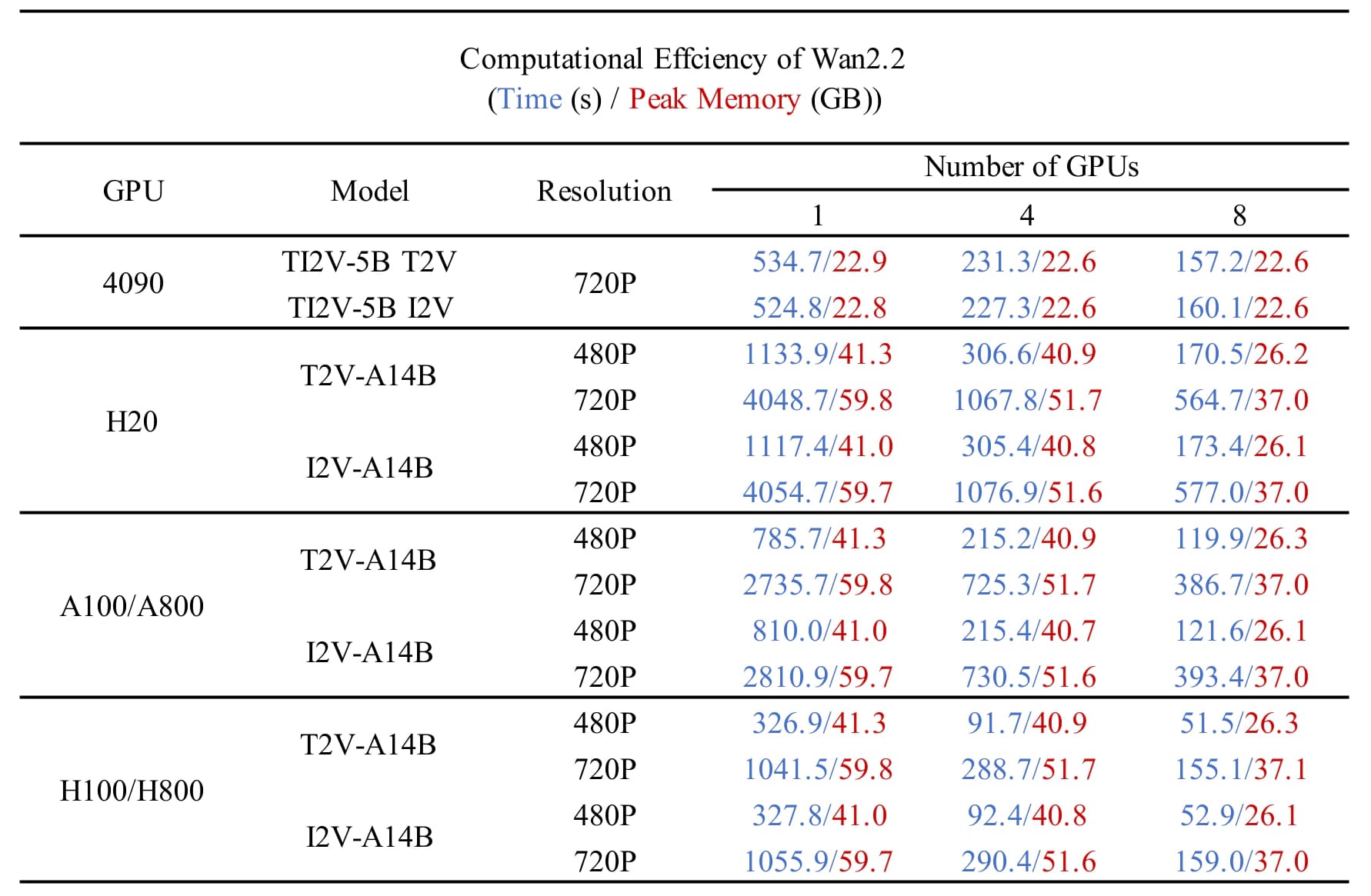
Wan2.2-T2V-A14B is the flagship: a 27B mixture-of-experts model with 14B parameters active per step, splitting denoising between a high-noise expert for layout and a low-noise expert for detail, at 480P and 720P in five-second clips. The model card recommends at least 80GB of VRAM for single-GPU inference. That is a rented H100, not a desk.
Wan2.2-TI2V-5B is the one most people should actually download. Five billion dense parameters, 720P at 24fps, five seconds, and a stated 24GB minimum that the card says runs on a single consumer 4090 in under nine minutes per clip unoptimized. Nine minutes per five seconds of video is the number to sit with before you commit to local generation.
The family keeps growing sideways rather than upward. Wan-Animate-2 landed August 7, 2026 under Apache 2.0: a 14B character-animation model that consumes a driving video directly for motion transfer and identity preservation, with a Lite variant distilled down to roughly ten inference steps for streaming use. Wan-Dancer-14B, a music-to-dance model, shipped a few weeks earlier on the same license.
One warning before you go shopping. There is no official Wan 2.5, Wan 2.6, or Wan 3.0 checkpoint on Hugging Face. The Wan-AI organization's newest text-to-video flagship is still the 2.2 family, and the pages confidently reviewing later version numbers are describing either an API-only release or nothing at all. If you cannot find the repository under Wan-AI, the weights do not exist.
HunyuanVideo 1.5 has the lowest VRAM floor
Tencent's HunyuanVideo 1.5 is 8.3B parameters, generates at 480p and 720p natively with a 1080p super-resolution stage, and lists a 14GB VRAM minimum with model offloading enabled. That is the lowest credible floor of any model in this tier, and it comes with first-class ComfyUI support rather than a research script. For anyone with a 16GB card, this is the one that will actually run.
Read the license before you build on it. It is tencent-hunyuan-community, not Apache 2.0, which means acceptable-use terms and conditions that Apache does not impose. Tencent also publishes HY-OmniWeaving, a unified multi-task checkpoint on the HunyuanVideo backbone that folds text-to-video, keyframe interpolation, reference composition, and video editing into one model, under a similar custom license.
The models to stop putting on these lists
Three names appear in nearly every open source video roundup and none of them are a reasonable choice in August 2026.
- Mochi 1 from Genmo is Apache 2.0 and 10B parameters, which sounds current until you read the specs: 480p output, and roughly 60GB of VRAM for single-GPU inference, or 22GB in the bf16 diffusers variant. It was a genuine milestone in 2024. It is now asking for more hardware than Wan 2.2 TI2V-5B while producing a quarter of the pixels.
- CogVideoX-5b generates 720x480 at 8fps for six seconds. It runs from about 5GB of VRAM, which is why it still gets recommended, and it still pulls around 18,000 downloads a month. Eight frames per second is a slideshow. Use it to learn the pipeline, not to make anything.
- Open-Sora is fully open including training code, which makes it valuable for research, but its GitHub releases page has not had a tagged release since V1.3 in February 2025.
None of these are bad projects. They are simply eighteen months to two years behind a field that reprices every quarter, and a roundup that lists them next to LTX-2.5 without saying so is wasting your download bandwidth.
What a local AI video generator actually costs
The pitch for a local AI video generator is that generation becomes free once the weights are on your disk. That is true of the marginal cost and misleading about everything else.
Start with the hardware. The cheapest credible entry is a 24GB consumer card for Wan 2.2 TI2V-5B or a 16GB card for HunyuanVideo 1.5, which is a used 4090 or a new 5090 in practice. The A14B tier wants 80GB, and MiniMax H3's own deployment recipe spans four GPUs, which means renting datacenter GPUs by the hour and putting you back in a metered relationship with a cloud provider, just with worse ergonomics. Note what that does to the quality argument: the best-looking open model is the one you are least likely to run at home, and local H3 caps at 768p, so the box you rented does not even give you the 2K the hosted version does. Then add throughput: nine minutes for five seconds at 720p on a 4090 means an afternoon of iteration produces a handful of usable clips, and video work is iteration-heavy because you cannot tell whether motion holds until you watch it.
Then add the setup. ComfyUI, the right custom nodes, a Python and CUDA toolchain that matches the model card (LTX-2.5 asks for Python 3.12, CUDA 12.7, and PyTorch 2.7), quantized checkpoints, offload configuration, and a VAE decode step that will happily exhaust your VRAM at the last moment. Most people who bounce off local video generation bounce off this part, not the GPU price.
What you get in exchange is real: no per-clip cost, total privacy, no content policy between you and your output, LoRA fine-tuning on your own footage, and no vendor able to change the rules or deprecate the model. For a studio building a repeatable pipeline, or anyone fine-tuning on domain data, that is worth the whole tax. For someone who needs twelve clips this week, it usually is not.
Open weights versus hosted, honestly
The comparison people expect here is quality, and quality is no longer where the gap is. Open weights lost the frontier to the closed labs over the past year, but LTX-2.5 with multishot and synchronized audio is not a downgrade from a hosted model for most work; it is the same class of output with a different delivery mechanism. The real trade-off is operational.
- Cost shape. Open weights are a large fixed cost (GPU, or hourly rental) and near-zero marginal cost. Hosted is zero fixed cost and a metered per-clip cost. The crossover is volume, and it is higher than people assume once you price a 5090 against per-clip credits.
- Time to first clip. Minutes hosted. An evening to a weekend locally, longer if your CUDA install fights you.
- Ceiling. Local caps out at whatever your card holds; you drop resolution, length, or precision to fit. Hosted runs the full-precision checkpoint on datacenter hardware every time. With H3 the ceiling is not even a hardware question: the 2K module is withheld from the open release, so local tops out at 768p no matter what you rent.
- Control. Only local gives you fine-tuning, LoRAs, custom nodes, and offline operation. If that is the requirement, nothing hosted substitutes for it.
- Durability. Downloaded weights cannot be deprecated out from under you. Ask anyone who built on Sora.
Which is why the choice is not actually ideological. Dream Pixel Forge runs both of the models at the top of this page in the browser, alongside Veo, Seedance, and Grok Video. LTX-2.5 sits on the standard tier with text-to-video and image-to-video at 720p or 1080p, clips from 5 to 20 seconds, and synchronized audio. MiniMax H3 is on the premium tier at 2K, 5 to 15 seconds, billed at 9 credits per second, which is the resolution the open checkpoints cannot produce. Same models as the download, no ComfyUI graph and no GPU. If you want the fine-tuning and the offline pipeline, pull the weights. If you want the output this afternoon, the hosted path exists for the same model, and the two are not in competition for the same hour of your day.
The workflow that saves the most money in either direction has not changed: approve a still in the freeform generator first, then animate that exact frame, rather than re-rolling a full video generation on every revision. We walk through it in image to video AI.
Free open source AI video generators, and where free stops
Every model on this page is free to download, which is not the same as free to use. Free splits three ways and only one of them is unlimited.
Free weights, your electricity. Wan 2.2 under Apache 2.0 is the closest thing to genuinely free forever: no revenue threshold, no acceptable-use annex, no seat count. Once the checkpoint is local, generation costs whatever your power company charges. The catch is the hardware you bought to get there.
Free under a threshold. LTX-2.5 is free for commercial and production use below $10M in annual recurring revenue, and a negotiated license above it. MiniMax H3 works the same way at a higher cap, under $20 million in annual revenue per SCMP's reporting, with attribution required and a separate application process if you are in the USA, EU, UK, or South Korea. For an independent creator or a small studio both are effectively free; for a funded company they are line items to check before shipping.
Free with terms. HunyuanVideo 1.5's community license permits a great deal but is not Apache, and the acceptable-use section is the part that bites later rather than at download time.
The thing no free tier gives you is the GPU. A free model on hardware you do not own is a model you cannot run, which is why hosted free trials remain the fastest honest answer for most people asking this question.
The best open source video model for each job
Rankings age badly, so here is the decision instead.
- Best measured quality: MiniMax H3, the highest-ranked open-weights model on the independent arena. The price is a multi-GPU host, a 768p ceiling locally, and writing the structured prompt yourself.
- Best overall for most people: LTX-2.5. Newest weights, multishot in one pass, synchronized audio, HDR output, quantized variants that fit real hardware, and a license that is free for almost everyone reading this.
- Best for reference-driven work: MiniMax H3, which takes stills, video, and audio references in one context window rather than one reference type at a time.
- Best if the license must be unambiguous: Wan 2.2, Apache 2.0, no threshold to track.
- Best on a 16GB card: HunyuanVideo 1.5, at a 14GB floor with offloading and mature ComfyUI support.
- Best on a single 24GB consumer GPU: Wan 2.2 TI2V-5B, 720p at 24fps, with published timings you can plan around.
- Best for character animation from a driving video: Wan-Animate-2, with a Lite variant fast enough for streaming.
- Best for robotics and world-model work: LTX-2.5's physical AI checkpoint, which is a pretrained base for domain fine-tuning rather than a cinematic model.
- Best if you do not have a GPU: a hosted AI video generator. LTX-2.5 and MiniMax H3 both run in the browser on Dream Pixel Forge, and hosted H3 is the only way to get its 2K output at all. The wider hosted field is mapped in AI video models in 2026, including Seedance 2.5.
The pattern worth noticing is that open weights consolidated around three Chinese labs and one Israeli company, while the American frontier labs went closed or went away. That has held for a year now, and today's LTX-2.5 release is the strongest evidence yet that the open tier is not settling for second place on quality, only on convenience.